 Zambezi River Tours
Best Time to Visit Victoria Falls: Month by Month
The best time to visit Victoria Falls depends on what you want to do when you get there. The Zambezi peaks around April, when the falls run at full width and the spray can swallow the viewpoints. By August the river has dropped, the rock face shows itself, and the rafting and Devil's Pool season opens. This guide walks through the falls month by month, compares the high-water and low-water seasons, and maps which activities run when. It also covers temperatures, rain, malaria season and how many days to set aside. When you have picked your dates, compare the cruises and rafting trips on this site to fill the itinerary.
Quick answer When to go
The best time to visit Victoria Falls for sheer volume is around April, when the Zambezi is at maximum flow and the falls run at full width. For clear photographs and easy walking, come in the dry months from May to July, when the mist eases but the river still carries force. White-water rafting and Devil's Pool run in the low-water months, roughly August to January, and rafting is often cited as best around October. October is also the hottest month, with highs that can pass 40°C.
Key takeaways
- See the month by month breakdown of water, weather and openings before you book flights.
- Match your dates to the activity: which activities run when lists rafting, Devil's Pool, moonbows and cruises.
- Rafting runs in low water. Read the season detail in the Victoria Falls white water rafting guide.
- Devil's Pool opens around mid-August. The full picture is in Devil's Pool at Victoria Falls.
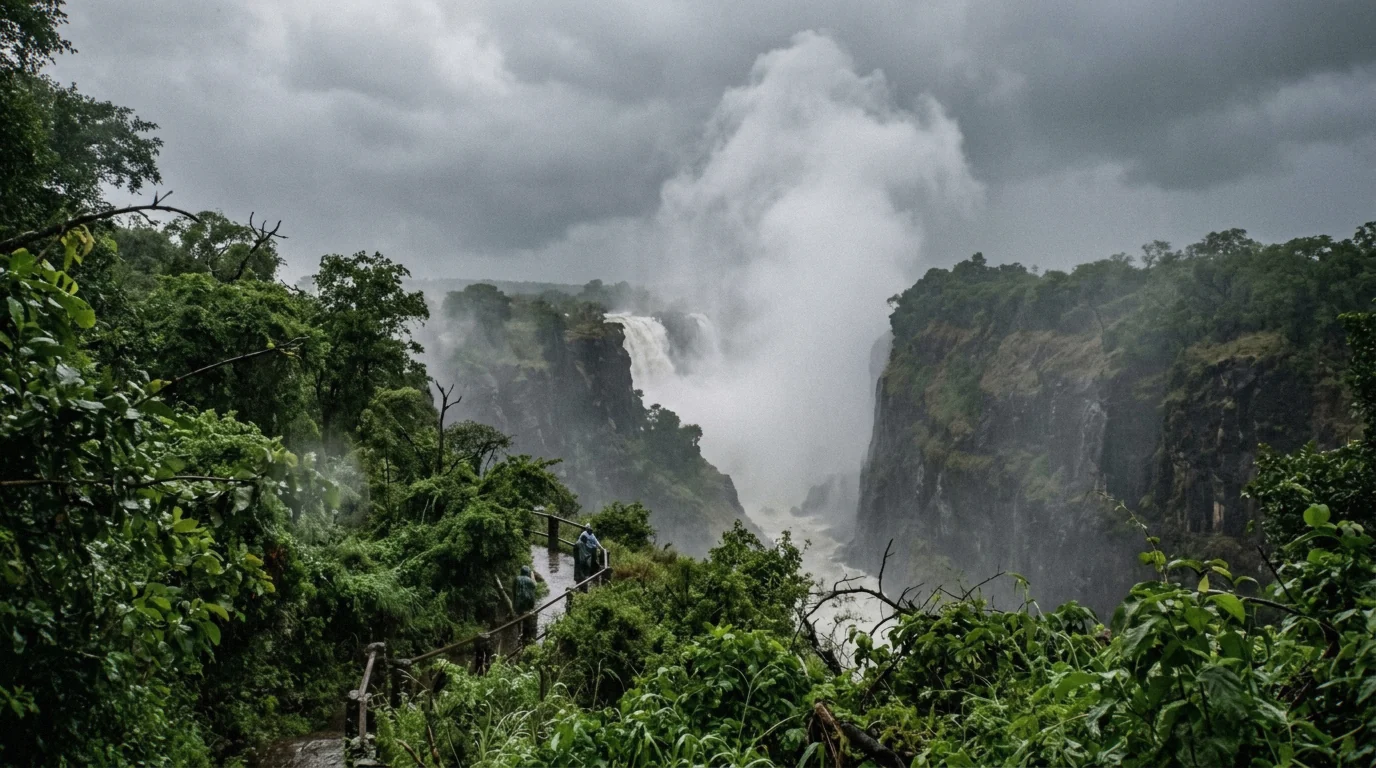
High water: spray can hide the falls.
Victoria Falls Month by Month
The Zambezi's flood season runs from February to May with maximum flow in April, and the river bottoms out around November at roughly one tenth of the April volume. The table below brings the water story and the weather story together, month by month.
The Twelve Months at a Glance
Temperature and rainfall figures come from published climate averages for Victoria Falls town, and the water and activity notes come from operator seasonal guides. Treat the rainfall numbers as long-term averages rather than a promise for any given week. The Zambezi does not follow the calendar exactly, so a heavy early wet season can shift the patterns shown here by several weeks.
The single most useful rule: high water brings maximum spectacle but minimum visibility, and low water brings the reverse. If the falls themselves are the priority, aim for the months where the water column still reads as strong in the table but the spray has begun to thin.
| Month | Water and spray | Weather | Open |
|---|---|---|---|
| January | High and rising, Devil's Pool season ending, rafting switching to the high-water run | Around 30°C, roughly 170 mm rain, one of the wettest months | Falls viewing, sunset cruises |
| February | Peak flood building, heaviest spray | Around 30°C, roughly 163 mm rain | Falls viewing, cruises, helicopter flights |
| March | Near peak flow, viewpoints veiled in mist | Around 31°C, roughly 140 mm rain | Falls viewing, cruises, moonbow on full moon nights |
| April | Maximum flow of the year, maximum spray | Around 30°C, roughly 76 mm rain as the rains taper | Falls viewing, cruises, moonbow, rainbows at their best |
| May | Still strong flow, mist starts to ease | Around 29°C, low rainfall, dry season starts | Falls viewing, cruises, moonbow, prime photography |
| June | High to medium water, clear conditions | Around 26°C with July the coolest month, essentially no rain | Falls viewing, cruises, dry-season walking |
| July | Medium water, dry and clear, strong game viewing nearby | Around 26°C, driest stretch of the year | Falls viewing, cruises, rafting window opening |
| August | Water dropping, rock face emerging | Around 30°C, essentially no rain, the driest month | Rafting and Devil's Pool open around mid-August, cruises, game drives |
| September | Low water, sculpted cascades, strong rafting | Around 34°C, dry | Rafting, Devil's Pool, cruises, clear falls views |
| October | Lowest river levels of the year, Zambia side can run thin | Hottest month, around 36°C, afternoon peaks above 40°C | Peak rafting, Devil's Pool, cruises |
| November | Annual low, first rains typically arrive, spray rises late in the month | Around 34°C | Rafting and Devil's Pool taper out, cruises |
| December | River climbing, Zambia-side cataract re-veiled in spray by month's end | Around 31°C, roughly 170 mm rain, afternoon storms | Falls viewing, cruises |
Sources: Victoria Falls, Wikipedia, Victoria Falls climate, climate-data.org
High Water vs Low Water
Everything about a visit to Victoria Falls, from the noise on the path to the activities on offer, flows from where the river sits in its annual cycle.
High Water: February to July
High water runs roughly from February to July and peaks around March and April, when the Zambezi spills over the full 1,708 metre width of the basalt cliff. This is the falls at its biggest: constant thunder, rainbows in the gorge and columns of spray that give the place its Lozi name, Mosi-oa-Tunya, the smoke that thunders. The trade-off is visibility. At some viewpoints the mist is so thick that you see white cloud rather than falling water, and you will get soaked on the rainforest path. A raincoat helps, and the guided falls tour from both sides supplies them.
If you are coming mainly for this display, May is a favoured compromise. Operators describe it as the point where the flow still feels dramatic but the mist eases, trails dry out and the light improves, which is why photographers often rate it the best single month.
Low Water: August to January
From roughly August the river drops and the rock face and gorge come into sharper focus. By October and November some sections narrow into cascades rather than a solid curtain, trading roar for visible detail. This is the season for adrenaline: white-water rafting in the Batoka Gorge and Devil's Pool on the lip of the falls both depend on low levels.
One thing low water does not mean is that the falls vanish. Sources frame the same visual effect differently. One operator guide says the Zambian side may dry up almost entirely to a bare rock wall around October and November. A second is more precise: the falls do not dry up, the water simply concentrates into fewer channels, and the Zambian Eastern Cataract carries a much smaller share of the flow than the Zimbabwean side. In practice this means the Zimbabwe side holds a respectable view right through the dry months, while the Zambia side can look thin at the tail of the dry season.
What the Seasons Do Not Change
The falls themselves are fixed: 108 metres high and 1,708 metres wide, the largest sheet of falling water in the world by the combination of the two, with an average annual flow of about 1,088 cubic metres per second. The upper Zambezi above the falls runs all year, which is why sunset cruises operate in every month. Hippo and Nile crocodile live in the river year round, and the dry months from May to October coincide with the best game viewing in nearby reserves, when animals concentrate around the remaining water.
Rainy season travel from December to March is the low season for tourism, so you trade crowded viewpoints for lower prices and lusher scenery.
Which Activities Run When
The falls are open all year, but most of the famous add-ons are not. This table compares the seasonal windows for the six activities travellers ask about most, based on operator seasonal guides.
Seasonal Windows for the Big Six
Rafting and Devil's Pool sit at the low-water end of the year, moonbows and rainbow photography sit at the high-water end, and cruises, game drives and the both-sides walk run year round. Exact opening and closing dates shift with each year's rains, so treat the months as a planning guide rather than a timetable. Book the water-dependent activities early in your stay so a weather cancellation leaves room to rebook.
| Activity | Best months | Closed or limited |
|---|---|---|
| White-water rafting | August to January, often cited as best around October (September also rates highly in some guides) | High-water trips from Rapid 11 instead of the Boiling Pot, and rafting can close entirely around April and May at peak flood |
| Devil's Pool | Roughly mid-August to January (some operators end by mid-December) | Closed through the high-water months, roughly March or April to May or June depending on that year's flood |
| Moonbow (lunar rainbow) | Full moon nights from March to May, visible in any month with enough spray, strongest February to August | Only on the three nights around each full moon, and needs high spray |
| Sunset cruises | Year round, boarding around 16:30 in summer and 16:00 in winter | None, though the dry winter months give the best wildlife at the riverbank |
| Both-sides falls walk | Year round, clearest views June to August | Rainy months bring mud and soaked viewpoints, late dry season thins the Zambia side |
| Game drives | May to October, when animals concentrate at water in nearby reserves | None, though the green wet season is lower season for sightings |
Rafting and Devil's Pool in Practice
The rafting run covers 23 kilometres of the Batoka Gorge on Grade 4 and 5 water. In low water the trip starts at the Boiling Pot below the bridge and runs rapids 1 through 19, including named monsters such as Stairway to Heaven and Commercial Suicide. In high water the put-in moves about 10 kilometres downstream to Rapid 11. The climb into and out of the gorge is steep, so you need reasonable fitness, and general operator guidance sets the minimum age at 15 with under-18s needing signed guardian consent. Individual listings differ: the full-day Shockwave rafting trip from Victoria Falls takes ages 13 and up, while the half-day Maano rafting trip from Livingstone is not suitable for under-12s.
Devil's Pool is a natural pool at the lip of the falls on Livingstone Island in Zambia, reachable only when levels are low enough to swim safely. Operators describe the closure window as variable and rainfall-dependent, and no official source publishes a fixed calendar date for it. The Devil's Pool guide covers the packages and what they cost.
Temperature, Rain and Malaria Season
Victoria Falls has a semi-arid climate: a hot, wet summer and a warm, dry winter. Average annual rainfall is somewhere between about 690 and 772 mm depending on the dataset, and almost all of it falls from October or November to March.
How Hot and Wet It Gets
Daytime highs run from about 26°C in June and July, the coolest months, to about 36°C in October, the hottest. October afternoons can pass 40°C, and night-time lows in October stay around 21°C, so there is little relief after dark. July nights can drop to about 10°C, worth remembering if you book a winter evening cruise.
Rain concentrates hard. January is the wettest month at roughly 170 to 200 mm over about 15 rain days, while July records almost nothing and August is essentially dry. The dry season from May to September brings the most comfortable conditions for walking: daytime temperatures around 26 to 30°C, humidity as low as about 24 percent and clear skies. The wet season brings dramatic afternoon thunderstorms, which are spectacular from the right terrace and inconvenient everywhere else.
Malaria Timing and Prevention
The Victoria Falls area sits in a malaria risk zone in both countries. Risk peaks during and just after the rains, roughly November to April, so dry-season visitors face lower exposure but not zero. Health guidance is the same year round: talk to a doctor or travel clinic 2 to 6 weeks before departure about prophylaxis, use repellent in the evenings and sleep under a net where provided.
The CDC's first-line tablet for this region starts 1 to 2 days before arrival, is taken daily and continues for 7 days after you leave. Book the winter months if you want the lowest-risk window without skipping the trip.
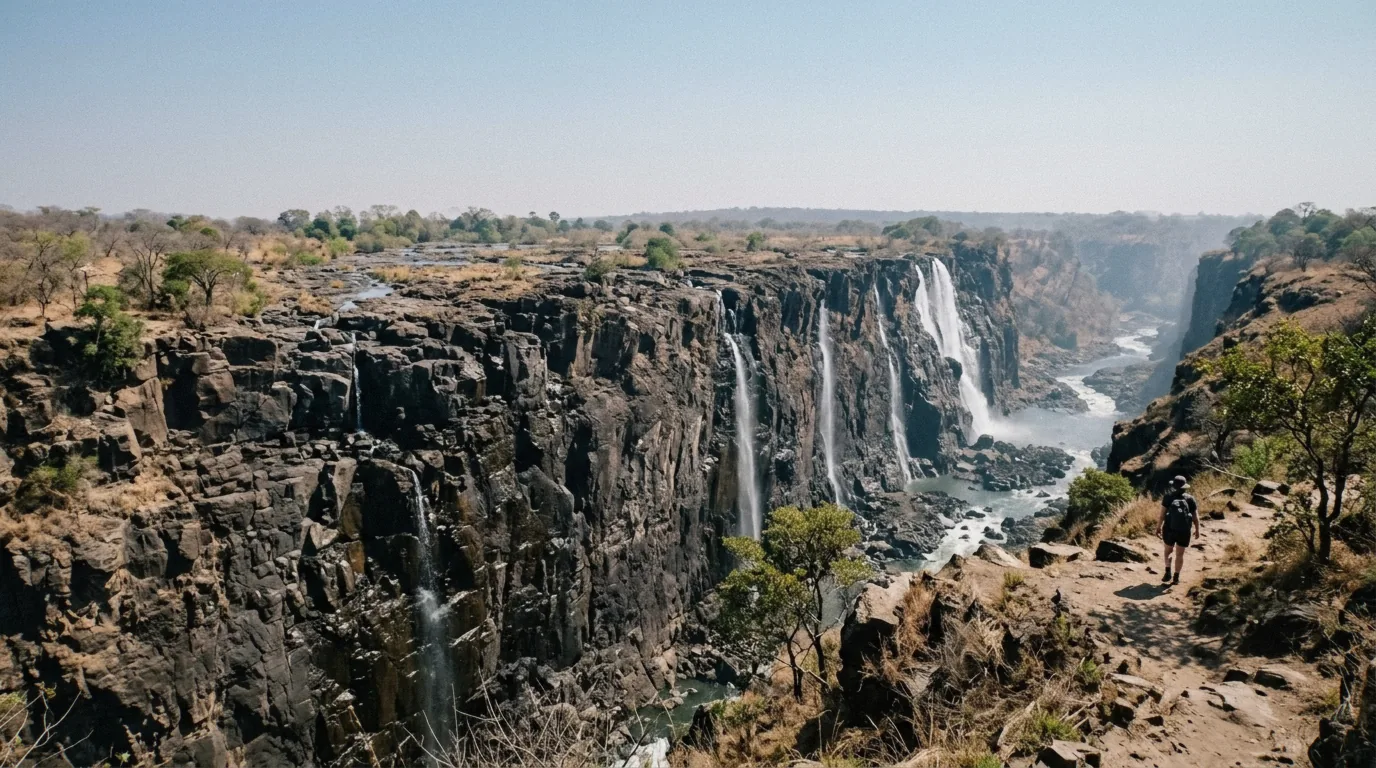
Low water: bare rock on the Zambia side.
How Many Days to Spend
Operator guides commonly recommend three nights at Victoria Falls. That is enough to see the falls from both sides, add a hero activity and still spend an evening on the river.
Why Three Nights Works
Three nights gives you four half-days, which maps neatly onto the core itinerary: the falls themselves on day one, the big seasonal activity on day two, a scenic flight or game drive on day three, and a sunset cruise to close. Fewer than two nights and you risk the weather wiping out your only falls day. More than four nights only makes sense if you are adding a safari extension into Chobe or Hwange, which sit in the same dry-season window from May to October.
A workable three-night plan looks like this. Arrive and walk the rainforest path on the side you are staying, ideally late afternoon when the light is low. On day two, take the guided falls tour from both sides, which crosses the Victoria Falls Bridge and covers both national parks in one six-hour day. On day three, pick your season: a full day of white-water rafting in the low-water months, or a helicopter flight and game drive in high water. On the last evening, a two-hour sunset cruise on the Zambezi Explorer gets you on the river with hippo and elephant along the banks. If you would rather eat on the water, the three-hour dinner cruise runs a four-course meal on board instead.
Zimbabwe or Zambia Side by Season
The season changes which country gives you the better view, which is why many visitors do both. The full comparison is in Victoria Falls: Zimbabwe or Zambia.
Which Side Wins in Which Season
In high water, Zimbabwe wins. Its rainforest path runs along the lip of the falls and delivers the classic wide-angle, full-curtain panorama, while the Zambia side at Knife Edge Bridge is so close to the Eastern Cataract that heavy spray soaks visitors outright. In low water, the balance shifts. The Zambia side gives closer, more intimate views and is where Devil's Pool operates, plus it pairs easily with river-based activities from Livingstone. The exception is the tail of the dry season around October and November, when Zambia's Eastern Cataract can thin to a trickle and the Zimbabwe side holds the better view.
Entry fees are part of the equation. Published fee schedules differ between sources. For the Zimbabwe rainforest, one aggregator citing ZimParks rates lists $50 per international adult, while another set of figures cites $58 at the main gate, and the both-sides guided tour listing states $58 on the Zimbabwe side and $20 on the Zambia side against its own $63 tour price. On the Zambia side, Zambia Tourism's own fee schedule lists $10 per non-resident adult while an aggregator lists $20. Because the numbers do not reconcile across sources, budget for the higher figure on each side and check the gate board on arrival.
Watch Before You Go
A third-party video, embedded from YouTube. We have no relationship with its creator.
Best Time to Visit Victoria Falls: Questions
Which month is best to visit Victoria Falls?
There is no single answer, but May is the strongest all-round pick. The river still carries dramatic force from the April peak, the mist has begun to ease, trails have dried and the light improves, which is why operator guides favour it for photography. If rafting or Devil's Pool is the priority, come between August and October instead. See the month by month table for the trade-offs, and check what the water level means for each trip in Victoria Falls white water rafting.
What time of year do Victoria Falls dry up?
They never fully dry up. Around October and November the river reaches its annual low, at roughly one tenth of the April volume, and the flow concentrates into fewer channels. The Zambian Eastern Cataract carries a small share of the river, so one guide describes it as drying back almost to a bare rock wall while another insists the falls simply thin out rather than vanish. Either way, the Zimbabwe side keeps a respectable view through the dry months. The seasonal detail is in the high water vs low water section.
Is it better to view Victoria Falls from Zambia or Zimbabwe?
In high water, Zimbabwe, because its rainforest path delivers the wide, full-curtain panorama while the Zambia side is drenched in spray. In low water, Zambia gives closer views and access to Devil's Pool, except in October and November when its side can run thin. Many travellers do both in one day on a guided falls tour from both sides, and the Zimbabwe or Zambia guide compares them in detail.
How many days do you need to visit Victoria Falls?
Three nights is the commonly recommended stay. That covers both sides of the falls, a sunset cruise and one seasonal hero activity such as rafting or Devil's Pool, with room for a scenic flight. Two nights is the practical minimum, and more than four only pays off if you are adding a safari extension. For ideas on filling the days, browse things to do in Victoria Falls.
When is Devil's Pool open?
Roughly mid-August to mid-January, when water levels drop low enough for safe swimming at the lip of the falls. Some operators end the season by mid-December, and the high-water closure window shifts each year with the flood, so no official source publishes fixed dates. Book early in the low-water window and read the Devil's Pool guide for package options.
When can you go white-water rafting at Victoria Falls?
The main low-water season runs roughly August to early January, starting at the Boiling Pot below the falls and running rapids 1 through 19 on Grade 4 and 5 water. October is often cited as the single best month, though some guides rate September just as highly. In high water the run starts downstream at Rapid 11, and rafting can close entirely at peak flood around April and May. Listings set their own minimum ages: 13 on the full-day trip from Victoria Falls and not suitable under 12 on the half-day trip from Livingstone.
Does season affect sunset cruises on the Zambezi?
Cruises run every month of the year, since the upper Zambezi above the falls never closes. What changes is the timing and the wildlife. Boarding is around 16:30 in the summer months and 16:00 in the dry winter, when earlier sunsets pull the departure forward, and the dry months bring the best animal sightings at the riverbank as animals come down to drink. Pick a departure on the sunset cruise comparison page.