 Zambezi River Tours
Victoria Falls Bridge: History, Border Crossing, Bungee and Tours
The Victoria Falls Bridge carries a road, a railway and a footway 128 metres above the Zambezi, right on the border between Zimbabwe and Zambia. Completed in 1905, it was conceived by Cecil Rhodes as part of his Cape to Cairo railway and today draws visitors for its history, its border crossing and the bungee jump, swing and guided tour that run from its deck. This guide explains how the bridge was built, how to walk onto it with a bridge pass, what the border post hours and visa rules mean for your trip, and what each Shearwater activity costs. If you are planning days on the water too, the comparison of every Zambezi tour side by side covers the sunset cruises and the white-water rafting that starts in the gorge directly below this bridge.
Quick answer The bridge in brief
The Victoria Falls Bridge was completed in 1905 and spans the Second Gorge of the Zambezi, 128 metres above the river, on the border between Zimbabwe and Zambia. It is 198 metres long with a main steel arch of 156.5 metres, and it carries a road, a railway and a footway. You can walk onto it from either country with a free same-day bridge pass, requested with your passport at the exit immigration post, without a visa. It is also home to a 111-metre bungee jump, a bridge swing, a bridge slide and a guided historic bridge tour run by Shearwater.
Key takeaways
- How the pass works, the border hours and the visa rules: see walking onto the bridge and crossing the border.
- Prices and heights for the bungee, swing, slide and tour: see bungee, swing, zipline and the bridge tour.
- See the falls from both countries in one day on the guided both-sides falls tour, which crosses this bridge.
- Torn between the two sides? Read Victoria Falls: Zimbabwe or Zambia?.
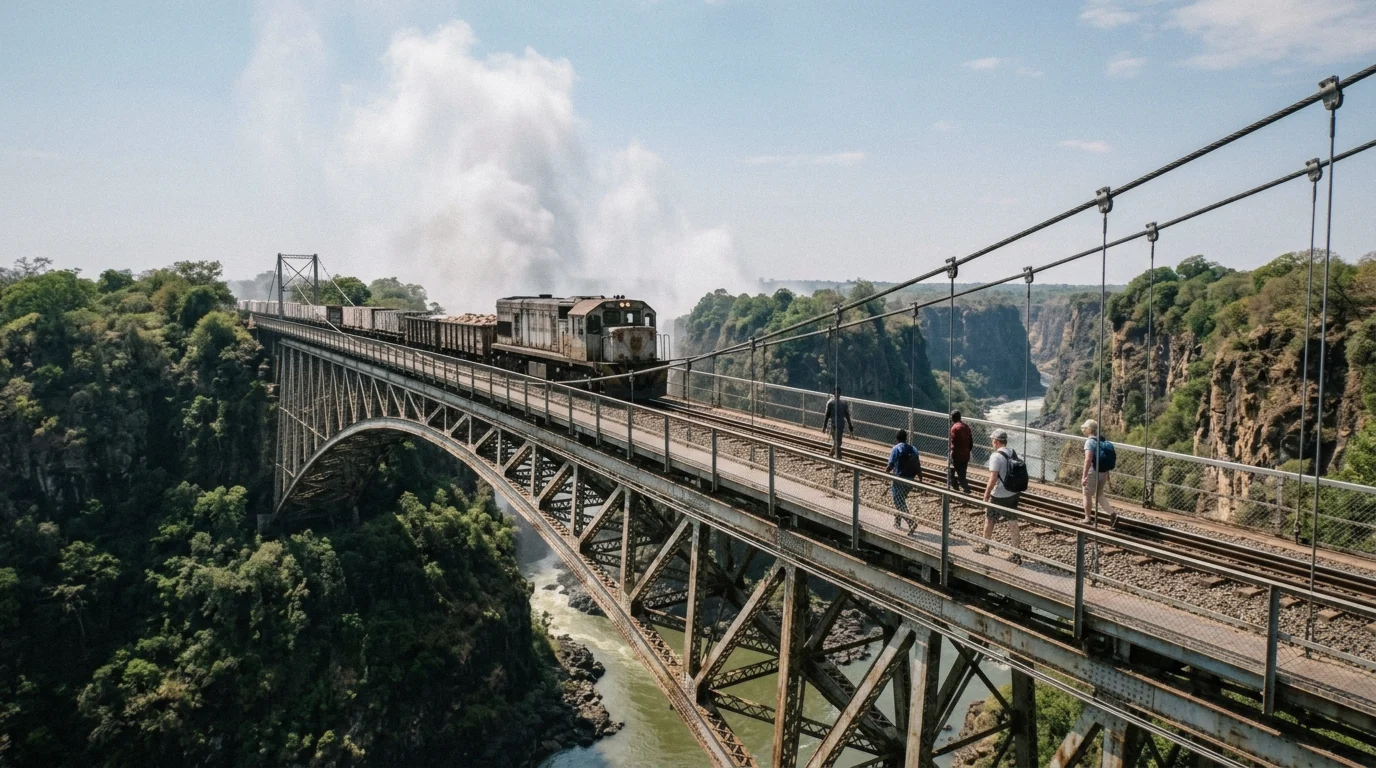
The bridge spans the Second Gorge.
History of the Victoria Falls Bridge
The bridge was dreamed up at the turn of the 20th century as part of a railway that was meant to run from Cape Town to Cairo. Its construction story is one of the great engineering feats of colonial Africa.
Rhodes and the spray of the falls
The bridge was the brainchild of Cecil Rhodes, who wanted his Cape to Cairo railway to pass close to the falls. He never visited Victoria Falls himself and died before construction began. His instruction to the engineers, as the story is usually told, was to build the bridge where the trains, as they pass, would catch the spray of the falls. The site chosen was the narrowest point of the Second Gorge, close enough to the falls for the spray to drift across the deck on high-water days.
The design came from George Andrew Hobson of the consultants Sir Douglas Fox and Partners, with stress calculations by Ralph Freeman, who later became principal designer of the Sydney Harbour Bridge and also worked on Zimbabwe's Birchenough Bridge. A single-span steel arch was chosen so the structure would not detract from the beauty of the site.
How it was built
The steelwork was prefabricated in Darlington, England by the Cleveland Bridge & Engineering Company, shipped to Beira in Mozambique and moved by rail to the falls. Construction started in 1904 and took 14 months. The arch was built out from both sides of the gorge and joined in the middle without scaffolding, since the gorge walls were far too steep to build from below.
Even before the bridge was finished, Rhodes had insisted that the railway line north of the gorge be laid first. To get rolling stock across, a locomotive was carried over the gorge in pieces on a temporary electric cableway nicknamed the Blondin and re-assembled on the far side. It entered service months before the bridge itself was complete. The bridge was officially opened on 12 September 1905 by Professor Sir George Darwin, son of Charles Darwin and President of the British Association. It was first called the Great Zambesi Bridge before the name Victoria Falls Bridge took hold, and the toll was abolished in 1906, a year after opening.
War, closure and recognition
The bridge's 20th century was turbulent. During the Rhodesian Bush War it was frequently closed, and in 1975 it hosted one of the stranger scenes in African diplomacy: Rhodesia peace talks held in a train carriage parked on the bridge, suspended above the gorge for nine and a half hours. The talks failed. Freight and road services resumed in 1980 and have run continuously since, apart from maintenance closures.
Age has brought restrictions. Trains cross at less than walking pace, and trucks were once limited to 30 tonnes, which forced heavier vehicles to divert via Kazungula or Chirundu. The limit was raised after repairs in 2006. The American Society of Civil Engineers has designated the bridge an International Historic Civil Engineering Landmark, and it ranks as the number two rated attraction in Victoria Falls on TripAdvisor, with more than 1,000 five-star reviews cited by the bridge company's own site. The dates below summarise the timeline.
Bridge timeline
These dates come from Wikipedia's bridge article and Siyabona Africa's history page, the two secondary sources behind most of what is published about the bridge's construction. They agree on the headline dates.
| Year | Event |
|---|---|
| 1900 | Rhodes commissions the bridge as part of the Cape to Cairo railway scheme |
| 1904 | Construction begins on site in the Second Gorge |
| 1904-1905 | The Blondin cableway carries a locomotive across the gorge in pieces before the bridge is finished |
| 12 September 1905 | Official opening by Professor Sir George Darwin |
| 1906 | Bridge toll abolished |
| 1975 | Failed Rhodesia peace talks held in a train carriage on the bridge |
| 1980 | Freight and road services resume after the Bush War |
| 2006 | Repairs allow the 30-tonne truck limit to be raised |
Bridge Facts and Figures
The headline numbers are well documented, though two sources disagree on the total bridge length. The table notes where that happens.
The key measurements
The bridge is 128 metres above the river at low water, which is why the bungee jump beneath it ranks among the highest commercial jumps in the world. It is the only rail link between Zambia and Zimbabwe and one of only three road links between the two countries, the others being the Chirundu Bridge and the Kazungula crossing. Wikipedia's length figure of 198 metres is the more precisely cited one.
Siyabona Africa gives 250 metres, which may include the approach roads or be a loose paraphrase, so sources differ on the overall length.
Figures at a glance
This table compares the key dimensions and status facts for the Victoria Falls Bridge and shows which source each comes from, so you can see where the two published sources agree and where they part ways.
| Measure | Figure | Source |
|---|---|---|
| Height above the river | 128 m above the lower water mark | Wikipedia and Siyabona Africa (agree) |
| Main arch span | 156.5 m | Wikipedia and Siyabona Africa (agree) |
| Total bridge length | 198 m (Siyabona gives 250 m) | Wikipedia (198 m is the more cited figure) |
| What it carries | Road, railway and footway | Wikipedia |
| Rail links between Zambia and Zimbabwe | Only one (this bridge) | Wikipedia |
| Road links between Zambia and Zimbabwe | One of three (with Chirundu and Kazungula) | Wikipedia |
| Construction time | 14 months, 1904 to 1905 | Wikipedia and Siyabona Africa |
| TripAdvisor rank in Victoria Falls | Number 2 attraction, 1,000+ five-star reviews | victoriafallsbridge.com |
| Designation | ASCE International Historic Civil Engineering Landmark | Wikipedia |
Five facts worth knowing
If you only remember a handful of things about the bridge, make them these. First, Cecil Rhodes never saw the falls and died before work began, yet his instruction that trains catch the spray shaped the site. Second, the steel arch was pushed out from both gorge walls and joined mid-air with no scaffolding underneath.
Third, Ralph Freeman, who checked the stress calculations, went on to design the Sydney Harbour Bridge. Fourth, in 1975 peace talks were literally parked on the bridge in a railway carriage for nine and a half hours and still failed. Fifth, it remains the only railway crossing between Zambia and Zimbabwe more than a century after opening.
Walking Onto the Bridge and Crossing the Border
The bridge links two countries, and the rules for stepping onto it are different from the rules for actually entering the other country. Here is how both work.
The free bridge pass
If you only want to walk onto the bridge and come back to the country you started in, you do not need a visa. Ask for a bridge pass at the exit immigration post and show a valid passport. You get permission to walk onto the bridge and return the same way, valid for that day. At the Zimbabwe post, bridge-only visitors are given a slip of paper stamped with the Zimbabwe stamp rather than a passport stamp. That slip is what gets you back into Zimbabwe afterward, so keep it safe.
One aggregated source states that a walk across the bridge costs $30, but this appears to conflate the bridge pass with the Zimbabwe single-entry visa fee of $30, which applies if you actually enter Zimbabwe. The more specific source describes the bridge-only pass as free.
Crossing into the other country
To walk into Livingstone, or into Victoria Falls town, you need a full exit stamp from your starting country plus a visa or visa-free entry for the destination. A Zambia single-entry visa costs around $50, and a Zimbabwe single-entry visa costs $30 for the nationalities that qualify for visa on arrival, which include citizens of the US, Canada, Australia, New Zealand, the UK, most of Europe and Japan. Citizens of SADC member countries such as South Africa do not need a visa for either country.
The better deal for most visitors is the KAZA UniVisa. It costs $50 and, effective 1 January 2026, that price is unchanged from prior years. It is valid for up to 30 days and covers unlimited crossings between Zambia and Zimbabwe, plus a Botswana day trip to Chobe as long as you return the same day. It is issued at Victoria Falls Airport and Livingstone Airport among other points, and it is available to nationals of roughly 50 or more countries. Note that the two border posts sit roughly 1.8 km apart, about a 20 to 30 minute walk end to end, and the walk across the bridge itself between the posts is roughly 2 km through a short stretch of no man's land. Taxis charge about $5 to $10 for the crossing.
Border post hours
The Zimbabwe border post at Victoria Falls moved to 24-hour daily operation on 13 November 2025, under Government Notice 2265A of 2025 issued by Zimbabwe's Secretary for Home Affairs and Cultural Heritage. Before that it closed at around 22:00, having opened around 06:00. The change means you can now cross late into the evening on the Zimbabwe side, though queues and staffing at night are not documented in the sources.
The exact opening hours for the Zambia-side post were not separately confirmed in the sources, so check locally before planning a very early or very late crossing. Driving between the two towns across the bridge is about 14 to 15 km, roughly 14 minutes excluding border formalities, and about 5 minutes between the two posts themselves.
Rules on the bridge
The bridge carries a public road, so stay within the permitted walking areas and do not block traffic lanes. The bridge is a popular photo spot, especially at sunrise and for rainbows in the spray. No official source publishes a formal photography ban, permit requirement or tripod restriction specific to the bridge or its border posts, so any claim of one should be treated as unverified.
General guidance is simply to be respectful of border staff and keep to the walkways. Be aware that there is no published confirmation of operating hours for the small free bridge museum on the Zambia side, so treat a visit there as a bonus rather than a plan.
Sources: allAfrica.com / Zimbabwe Government Gazette, victoriafallsafrica.com, torntackies.com
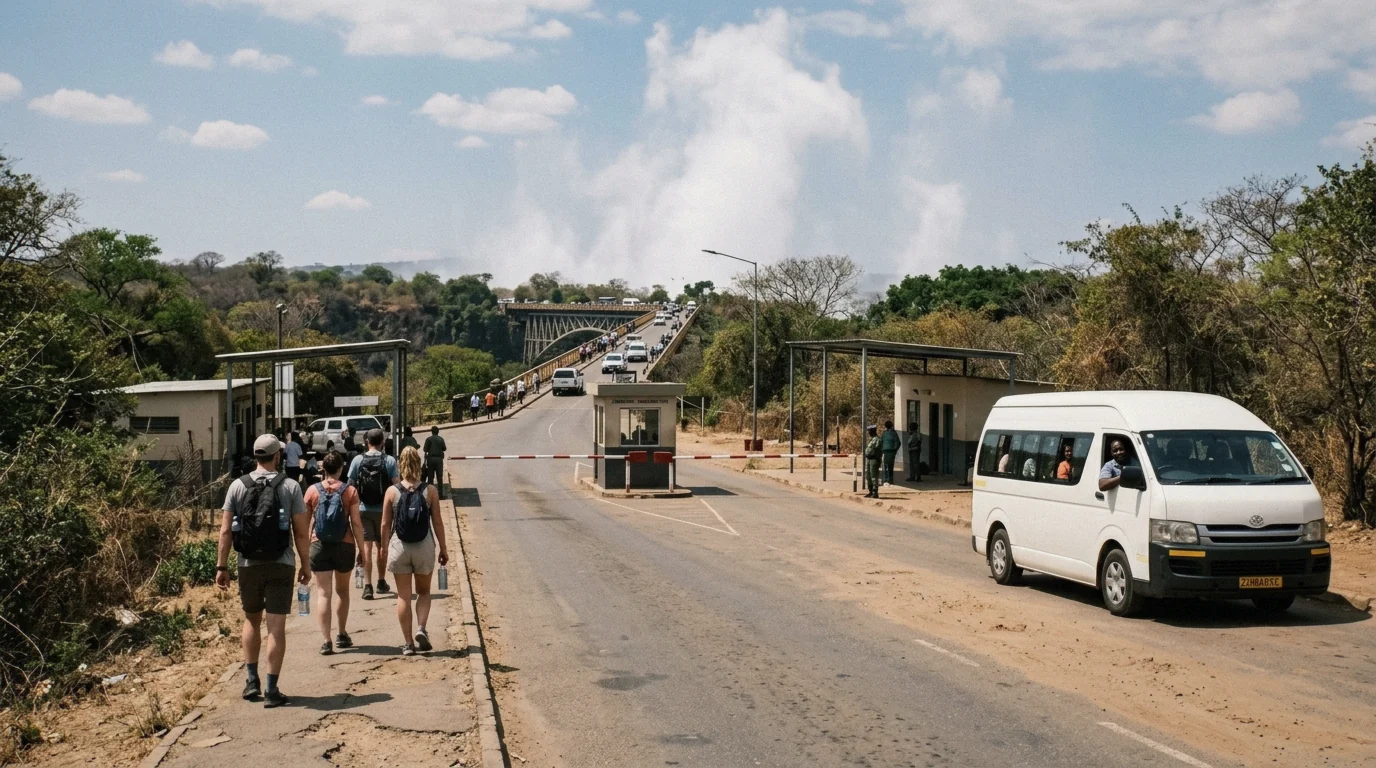
Border posts stand at each end of the bridge.
Bungee, Swing, Zipline and the Bridge Tour
Shearwater runs five activities on the bridge, and its own site publishes the prices.
What each activity involves
The bungee jump is a 111-metre drop with about 4 seconds of freefall before the cord stretches and the team recovers you. The bridge swing is a pendulum freefall of up to 70 metres before you swing out in an arc over the Zambezi rapids, launched from walkway platforms under the deck, with forward, backward or tandem options. The bridge slide crosses the Batoka Gorge from the Zambian side and lands you on the bridge, open to ages 6 and up.
The historic bridge tour is a theatrical guided presentation on the bridge and its 1904 builders, with access to catwalks beneath the deck that are normally closed to the public, plus a chance to see full circle rainbows in the spray. A passport is required to access the bridge area for any of these. Note that Shearwater's Big Air package page describes its own bungee as a 100-metre jump, which conflicts with the 111 metres on the dedicated bungee page.
The bungee drop of 111 metres is shorter than the bridge's 128-metre height because the platform sits under the deck and the cord does not reach the river.
Prices and details compared
This table compares Shearwater's five bridge activities using the figures published on shearwaterbungee.com, the operator's own site. The Historic Bridge Tour price differs on a secondary source, which lists $55 plus $15 for pickup, so the current official figure is given and the discrepancy noted.
| Activity | Height or length | Price | Operator |
|---|---|---|---|
| Bungee Jump | 111 m drop, about 4 seconds of freefall | $194 | Shearwater |
| Bridge Swing | Freefall up to 70 m | $137 solo, $201 tandem | Shearwater |
| Bridge Slide | Crosses the Batoka Gorge from Zambia onto the bridge | $58 solo, $82 tandem, ages 6 and up | Shearwater |
| Historic Bridge Tour | About 2 hours, catwalks under the deck | $64 per person (an older secondary source gives $55 plus $15 pickup) | Shearwater |
| Big Air Experience | Bundle of bungee, swing and slide | $250 | Shearwater |
Practical details for the bridge tour
The Historic Bridge Tour runs about 2 hours with departures at 10:00 and 14:30, and check-in is 30 minutes before departure. The minimum age is 10 and there must be at least two people per group. A complimentary shuttle leaves the Shearwater Cafe in Victoria Falls town at 10:00 and 14:00 daily, and a paid return transfer costs $12 per person. Each Shearwater bridge activity has a turnaround time of about 1 hour, excluding getting to the bridge.
Wild Horizons, the other major adventure operator in town, lists ziplining, gorge swing and canopy tours among its activities, but does not publish standalone prices for bridge-based activities on its homepage, so no figures are quoted here. No confirmed operating hours were found for the small free bridge museum on the Zambia side, and no current standalone zipline price has been published by Wild Horizons.
Sources: Shearwater Bungee, Shearwater Victoria Falls
The Best Views of the Bridge
The bridge photographs well from almost every angle, but a few viewpoints stand out.
From the rainforest trails and the Zambia side
The rainforest trails on the Zimbabwe side run along the lip of the falls, and on clear days the arch of the bridge is visible downstream through the spray. On the Zambia side, the paths through Mosi-oa-Tunya National Park toward the Eastern Cataract give a side-on view of the gorge with the bridge spanning it. The Zambia side is also where the free bridge museum and cafe sit, next to the border post.
A simpler option is to walk onto the bridge itself with a bridge pass and look straight down the 128 metres into the Second Gorge. Sunrise shots and rainbows in the spray are the classic images. Dry season months from around June to August give clearer air and less spray to shoot through.
From the gorge below
The most dramatic view is from underneath. Low-water white-water rafting starts at the Boiling Pot, the churning pool directly beneath Victoria Falls Bridge, reached by a steep hike down into the Batoka Gorge. The low-water run starts right under the span. If you want that perspective without paddling, the guide to Victoria Falls white water rafting covers the seasons and the rapids, and you can compare the trips themselves on the tour comparison table, including the full-day rafting trip from Victoria Falls and the half-day trip from Livingstone.
To see the bridge in context with the falls, the guided tour of the falls from both sides crosses the bridge and walks both rainforest trails in a single six-hour day.
Watch Before You Go
A third-party video, embedded from YouTube. We have no relationship with its creator.
Frequently Asked Questions
What is the history of the Victoria Falls Bridge?
It was conceived by Cecil Rhodes for his Cape to Cairo railway, designed by George Andrew Hobson with stress calculations by Ralph Freeman, and prefabricated in Darlington, England before being shipped to Beira and railed to the site. Construction took 14 months and it was officially opened on 12 September 1905. In 1975 it hosted failed Rhodesia peace talks in a train carriage on the span. Read the full story in the history of the bridge section.
Is it possible to go bungee jumping at the Victoria Falls Bridge?
Yes. Shearwater operates a 111-metre bungee jump from the bridge, with about 4 seconds of freefall, listed at $194, alongside a bridge swing, a bridge slide and a combined Big Air Experience at $250. Details and prices are in the bridge activities section.
Is it better to see Victoria Falls from Zambia or Zimbabwe?
Both sides have merits, and the bridge crossing makes it easy to do both. The Zimbabwe rainforest has the longer frontage on the main falls, while the Zambia side offers close-up views of the Eastern Cataract from Knife Edge Bridge. The guided both-sides falls tour crosses the bridge and covers both in one day, and the comparison of Victoria Falls from Zimbabwe or Zambia weighs them up in detail.
What are 5 facts about Victoria Falls?
The falls are 108 metres high and 1,708 metres wide, the largest waterfall in the world by that combination. Average annual flow is about 1,088 cubic metres per second. The name Mosi-oa-Tunya means the smoke that thunders in the Lozi language. The site became a UNESCO World Heritage Site in 1989. The Victoria Falls Bridge below the falls opened in 1905 and remains the only rail link between Zambia and Zimbabwe. More context is on the Zambezi River guide.
Do I need a visa to walk onto the Victoria Falls Bridge?
No, if you only want to step onto the bridge and return to your starting country. Request a free same-day bridge pass with your passport at the exit immigration post, and keep the stamped slip you are given, since that is what gets you back in. To actually enter the other country you need a full visa, or a the KAZA UniVisa explained in the crossing section.
Can you walk across the Victoria Falls Bridge between Zimbabwe and Zambia?
Yes. The walk between the two border posts is roughly 2 km and passes through a short stretch of no man's land. The posts sit about 1.8 km apart, a 20 to 30 minute walk end to end, and taxis charge about $5 to $10 for the same journey. The Zimbabwe post now runs 24 hours a day. Practical details are in the border crossing section.
How high is the Victoria Falls Bridge?
The deck sits 128 metres above the lower water mark of the Zambezi in the gorge below. The main steel arch spans 156.5 metres, and the bridge is 198 metres long overall, though one source gives a different total length. The figures and their sources are in the facts and figures table.